Now We’re Getting Somewhere

Well, it certainly has been a while, hasn’t it?

It is fair to say that the general lack of activity on this blog has been directly related to the lack of significant progress on Vespers. While much of that has been due to the inconsiderate intrusion of Real Life on the development process over the past, oh, 18 months or so, a fair share of the stagnation was also due to an unfortunate combination of bad luck, shortsightedness, and an incredibly exasperating game engine.

I’ll conveniently ignore the former stuff, and expand just a bit on the latter.

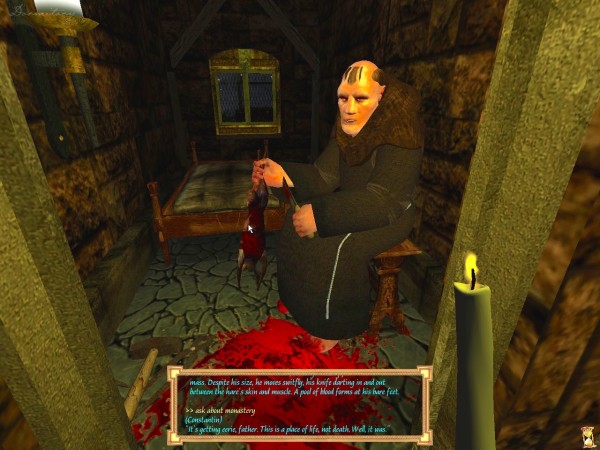
Lucca and Constantin

An actual, honest-to-goodness screenshot of the cutscene. Seriously.

As I’ve discussed in earlier posts, most of what I’ve been focusing on since last fall (or so) has been the first cutscene, since the demo will be all of the action leading up to, and including, the first cutscene. Of course, in the original text version of Vespers there is no cutscene per se, but there is a short sequence of events that spans a few turns and which the player has no control over and cannot interrupt. So in a sense, it’s a scene playing out over three or four turns regardless of what the player tries to do, which is really not that different from a short cutscene. So that’s how I decided to implement it, despite all of the discussion on the interwebs over the past few years about how cutscenes are evil and kill puppies.

Rather than play a pre-rendered cutscene movie like some games, I wanted to have one rendered in-game, using the same character models used throughout the first Act, with some creative scene design, lighting, and camera manipulation thrown in. Not really a big problem conceptually, but reality doesn’t often play nice with concept, and this situation was no different.

Now, rather than bore you with the details of all that went wrong over the past six months or so, let’s just say that most of the issues could be traced back to three key things:

1. Some of the character models weren’t originally set up exactly as I needed them to be;
2. The animator used a separate copy of each character in order to make the cutscene animations; and
3. The Torque Game Engine is very fussy about a lot of things when it comes to playing animation sequences.

Basically, in Torque, you create a character model, rig it with a “skeleton,” and then create animation sequences for that skeleton. Different models can use the same skeleton, and any animation sequences developed for the skeleton will work with any model that uses that skeleton. The only requirement is that the skeleton must be constructed precisely the same way, down to the very last tiny little detail, for an animation sequence to work with it. Generally speaking, this is not a problem. But along came #2 above, and with it came some minor but undetected changes to skeletal structures that couldn’t possibly get past #3 above. Some of these were easily correctable, some not so much. Extra time, workarounds, and so on, you get the picture.

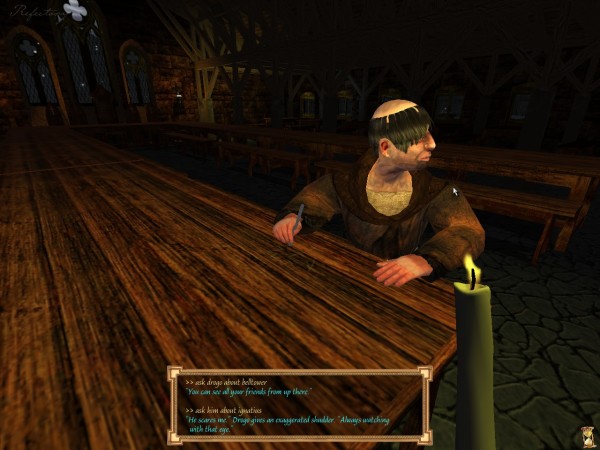
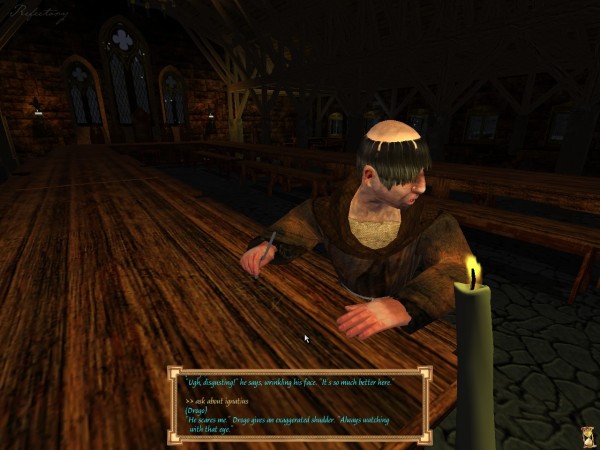
Ignatius and Drogo

There isn't a video of this anywhere...is there?

In the midst of this came the realization of #1 above, and the need to fix some of these seemingly minor but ultimately important model structure issues. But naturally, making changes to model and skeletal structures led me once again into the endless pit that is #3 above. So not only would I have to update and recreate the models and animations for the cutscene, but the same would apply to all of the animations for these characters for Act I. It became like a revolving door, round and round from the cutscene to Act I and back again.

With the additional constraints of time and life on top of everything else, it began to feel like I was on a Road to Nowhere at times.

Fortunately, I was able to find a few great people to help, people who know a lot more than I do about the baffling intersection between modeling, animation, and the Torque Engine. With a little persistence, a great deal of assistance, and a whole slew of questionable workarounds, I was finally able to push through it. And now we have a cutscene.

It still lacks a background musical score, which I’m in the process of working on, so overall it seems strangely quiet. But it’s all there, it’s all coded, and it runs smoothly from start to finish with all the right camera shots, pans, and sound effects. I’m quite relieved.

Now all I have to do is go back and re-export a whole mess of Act I animations…again.


2 people like this post.
Posted in Vespers | 2 Comments

All’s Well That Ends Well?

Some encouraging news, for a change.

My last post, back in November (really?), discussed how the parent company behind the Torque Game Engine, the engine I’m using for Vespers, was shutting down the portion of the company responsible for engine development. I think a lot of people saw that coming. The original company, GarageGames, was a small, friendly, down-to-earth group of people that had a passion for helping other people make games, and it helped them build a strong game engine and a large, fairly devoted community. The employees spent a good deal of time on the forums interacting with the customers and developers, and this created a nice connection that a lot of people appreciated. Then things started changing. They expanded their product line, perhaps a bit too fast and a bit too wide, and ended up stretching themselves too thin. They changed their name from friendly GarageGames to the slightly weird and distinctly unfriendly TorquePowered. Focus began to shift to online gaming, away from their core of PC/Mac development. One by one, many of the original employees resigned to join other companies or pursue other opportunities. They were bought out by IAC, a large corporation, and while they tried to spin it to their advantage, there was no overcoming the sense that they had sold out. When they moved from cozy Eugene, Oregon to vapid Las Vegas, the transformation of the original company appeared to be complete.

It was a sad day when it was announced that the parent company overseeing Torque was shutting down its operations, but to be honest I think most people had already been saddened for some time by what appeared to be the prolonged and inevitable death of GarageGames.

Importantly, though, those of us who were still in the process of developing games with Torque engines – and who cringe at the prospect of porting to a new game engine – had to patiently wait to see what would happen to the Torque product line, and how it would affect licensing issues. (Of course, that would only be important to people who actually release finished games, so just pretend for now that it was of great concern to me.)

So with yesterday came the announcement of the rebirth of GarageGames. The company and the product line is now a subsidiary of Graham Software Development, and the decision was made to relaunch the company under their original name and with a commitment to return to its “indie roots.” There is a renewed focus on the community, perhaps Torque’s strongest asset, and a desire to make the Torque products more stable, more intuitive, and better documented. They’re reducing their product line so that they can focus on fewer engines, and dropping the prices on all of their engines to $99 to celebrate.

This is all good news, of course, and it is comforting to know that licensing is no longer a concern. It’s also good to know that I won’t have to update the “GarageGames” logo on my splash screen, which I thankfully never updated to “TorquePowered”.

Still, I’ll view these events cautiously. GG is saying the right things, and I like that the focus is back on the community. That would be a wise move. But it’s not like we haven’t heard much of this before; better documentation has been an issue with Torque products for years, and has been promised many times. There is still the fact that many of the original GG guys have moved on to other pursuits, and they’re not only still in Vegas, they’re moving into an even larger office building. Their image has taken a multitude of hits over the past few years, and it will take some work to repair that.

But they do have two big advantages in their product line and their large community, and full access to the source code at such a low entry price is very good. It’s good to see GG back and on what appears to be the right track. We’ll have to see where they take it this time.

1 person likes this post.
Posted in indie game business, Vespers | Leave a comment

Whither (Wither?) Torque

Thanks to Rampant Coyote for bringing this to my attention, but for those of you who haven’t heard, InstantAction has decided to shut down its operations. While this is certainly sad news for a number of people who will be out of work, a lot of you are probably saying, “Who?” The truth is that I’m not sure I could accurately explain exactly how this relates to me, even though it does.

About three years ago, GarageGames – the company responsible for developing and selling the Torque Game Engine (TGE), the 3D engine I’m using to make Vespers – announced a ‘partnership’ with InterActive Corporation (IAC), which is just another way of saying that GarageGames was bought out by IAC. The idea, at least as I understand it, was to redirect the development of the Torque line of game engine products to support a new gaming platform called InstantAction. I never really played around with InstantAction, but basically it was something akin to a web-based console where players could play various 2D or 3D games, most of which would presumably be made with Torque products. Continued effort was put into developing the various lines of Torque engines, but a lot of it was banking on InstantAction becoming a popular and profitable gaming portal. In the meantime, GarageGames re-branded themselves as TorquePowered, and after some time moved away from their origins in cozy Eugene, OR to, of all places, Las Vegas. Turns out the move was basically a metaphor of what was happening to GarageGames as a whole, as it evolved from a small, friendly, close-knit group to a larger, more faceless, corporate presence.

The guys at TorquePowered tried hard to put a pretty face on those developments, but the Torque community was largely wary and suspicious, and in the end they were probably right to be. Nobody can say for sure if GarageGames could have continued to survive without being bought out by IAC, but there’s no arguing that those events forever changed the company and their relationship with their community.

It’s hard for me to say what exactly it means that InstantAction, IAC’s flagship online gaming portal, has gone belly-up, at least with respect to the Torque engine. I don’t have any familiarity with IAC or its subsidiaries, but it seems that the entity that InstantAction represented must have had ownership of the Torque line of products, since today’s announcement was that “Torquepowered.com will continue to operate while InstantAction explores opportunities with potential buyers for Torque.” So InstantAction, as a company, apparently owns the Torque product line, and now we’re seeing the demise of InstantAction. So it goes.

Whatever the case may be, this means that TGE, the core engine of Vespers, is now officially in limbo, its future uncertain.

The ultimate impact is likely to be minimal, but I can’t say for sure. The most likely scenario is that some company will buy the Torque line and continue to honor the current licenses. You never know, though, and it’s a little harder to predict what will happen specifically to TGE (the engine I’m using, not their newer, fancier engines), since it’s an older, out-of-date product that wasn’t even being supported by TorquePowered (nee GarageGames) anymore. We’ll probably know more in the coming days and weeks.

I can’t help but think of a time, probably around five years ago, when I was about to embark on this project, and I was looking for a game engine to use. I had narrowed it down at the time to the Torque Game Engine and the Unity Engine. I liked Unity specifically because it was Mac-based, but at the time it was still very young and its future was not well outlined; its community was also small and there were plenty of engine features that had not yet been implemented. TGE, on the other hand, had a more mature code base and its community was quite large and helpful. Plus, it was cross-platform. I chose TGE, but I always kept an eye on Unity.

Unity is now thriving, of course, and is probably the leading indie game engine out there. TGE, on the other hand, is outdated, no longer supported, and is now adrift at sea.

Yes, it looks like I chose Betamax. Ah, well. We’ll see what happens from here, but I’ll keep plugging away.

1 person likes this post.
Posted in indie game business, indie games, Vespers | 1 Comment

Who Wouldn’t Be Inspired By This?

As some of you may have gathered by now, I like documentaries. And I’m a nerd. So nerd documentaries are like magical gifts from above.

Jason Scott has made two of them, BBS: The Documentary and, of course, GET LAMP, and both are excellent and clearly targeted to my demographic. I think our successful showing in Salt Lake proved that you don’t have to be a total nerd to enjoy them, but truth be told, they’re not for everybody. But courtesy Jason, another film about a subject close to my heart has appeared on the horizon, although this may be old news to some.

Indie Game: The Movie is a feature documentary being made by James Swirsky and Lisanne Pajot of BlinkWorks, which covers indie video games, their creators, and the craft. How cool is that?

The teaser segment above features Edmund McMillen of ‘Team Meat’ discussing his childhood, his games and the connections between. The film itself was inspired by their experience covering the Game Developers Conference in Spring 2009, which led to a short film they made on Alec Holowka of Infinite Ammo in Fall 2009:

One thing that stands out about these clips is the quality. They appear to be excellent filmmakers, with strong camerawork, good interviews, nice storytelling, and editing that appears very smooth and well done. Hard to say for certain with the short clips, and I’m not familiar with any of their previous work, but the teasers so far are very promising.

The project, like many others, began as a Kickstarter project sometime this past summer. The goal was to raise $15,000, and they managed to get over $23,000. I love the Kickstarter idea, and I have backed maybe a half dozen Kickstarter projects over the past year or so, but somehow I never caught this one until now. You can still back it, either through their Kickstarter page or directly from their web site, and I plan to do so.

If I was really up to it, I could donate a nice chunk of cash and get a two minute trailer of Vespers included in the credits and on their web site. I’m just not sure it would be fair to do so with a game that is still so far from being finished…

1 person likes this post.
Posted in indie games | Leave a comment

Time…Marches On

So last night was the latest Utah Indie Gamer night, and I couldn’t make it. Bums me out a bit, because I enjoy connecting with those folks and following along with some of their projects, especially Jay Barnson’s Frayed Knights. At the same time, though, each successive gathering just seems to highlight the fact that I still haven’t reached any major milestones on this project.

It’s now the end of October, and still no Vespers. Still no demo. Seriously, what gives?

Fine, so four and a half years into the project, I’m willing to admit it’s taking slightly longer than anticipated. It was a struggle to finally reach that conclusion, but there you have it. I thought I was choosing a relatively small, concise project for my first go at 3D/IF, but I suppose choosing a project should probably be kind of like packing for a long trip – set out what you think you’ll need, and then eliminate half of it. “What you want it to be” is probably a lot more than “what it really should be,” no matter what your starting point is.

This is my hobby, so while it tends to consume me at times, it still falls relatively low on the Life Priority scale, even when there are deadlines approaching. And I’m still highly dependent on others for needed content, and those deadlines don’t necessarily apply to them. Nevertheless, we continue the slow, plodding, inevitable march forward. Oh yes, it is inevitable. Like erectile dysfunction or a colonoscopy, it’s coming whether you like it or not.

I’ve made no attempt to hide the fact that animation has been the greatest challenge of this project. Hard to imagine how many different animators have come and gone on this project, but let’s face it: this is not your typical 3D first-person animation job.

That said, I did find a wee bit of stability with one animator, Kevin Grove. New to the project, Kevin took on the unenviable job of animating Cecilia during the first Act, which is anything but a simple task. Unlike the other characters, Cecilia exists in multiple stages throughout Act I, so there are different root poses, different meshes, and a number of sequences that have to be timed and positioned just right. Very different from the other characters to this point. I’ll go into that more in a later post.

Kevin was just what I needed, and he slowly worked his way through all of Cecilia’s animations for Act I. This was incredibly tedious work, with a lot of back-and-forth between us so we could get things just right. I still have a number of animations to implement in the game, but it’s a relief to know all of the content is there for Act I now. It’s all just a matter of putting it together within the game.

Same goes for the first cutscene, which is the longest and most involved of the cutscenes. Fortunately, my other animator, Lem, came back into the fold long enough to knock out all of those animations. This was a seriously complex task, requiring him to animate four characters in the same scene, all interacting with each other, while following a storyboard. The results look fantastic so far.

But it’s not just the animators holding things up, really; it’s the whole Torque animation system, starting with the exporting of animations as separate files (.DSQ files) from the modeling and animation software, and ending with the proper loading and execution of those animations in the game. It should be the easiest part of the process (compared with animation development itself), but the reality is that Torque’s animation system is old, cryptic, and unpredictable. Animations may or may not work when exported, body parts may fly in unexpected directions (if they appear at all), and results may look different even just on successive playthroughs. Documentation on the process is nearly nonexistent. It’s maddening at times; in fact, seeing animations work they way they’re supposed to is uncommon enough to be surprising. The instant you think you’re getting the hang of it is the moment Torque throws something completely new and baffling at you, knocking you back down to earth.

The good news is that content is slowly but surely getting done, and I have enough content at this point to essentially finish the demo, which will consist of Act I and the first cutscene. I’ve been working with N.R. to finish the remainder of the modeling content for the rest of the game, and although we’re close, things may slow down as he concentrates on other work. The problem, as always, will be the animation. But I have an idea about that, and I’ll talk about it more on a later post.

Be the first to like.
Posted in 3D/if, Vespers | 4 Comments